Eyewitness to Infamy by Paul Joseph Travers
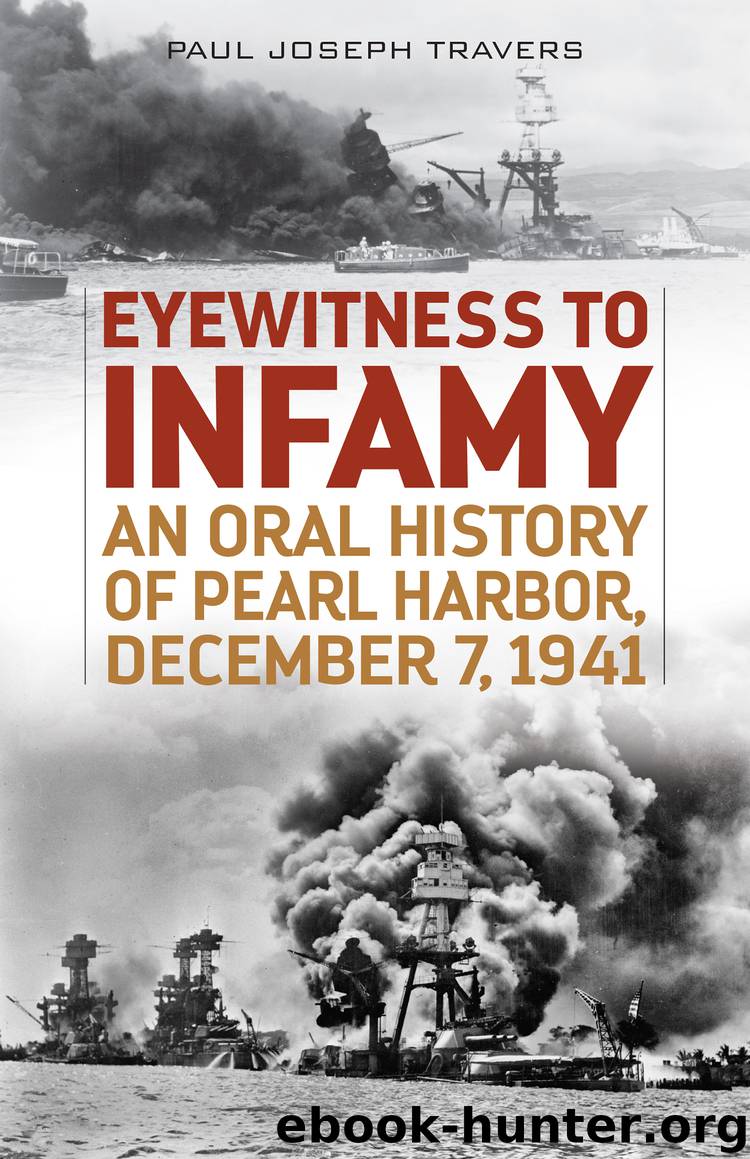
Author:Paul Joseph Travers [Travers, Paul Joseph]
Language: eng
Format: epub
Publisher: Lyons Press
Published: 2016-04-10T04:00:00+00:00
Carl Whitaker remained in the navy and retired at age thirty-eight with twenty years of service. Whitaker found the solution to the problem facing many retired servicemen by developing new skills and improving on old ones at colleges and universities near his home in Long Beach, California. At age fifty-nine, he retired from a position with the Los Angeles Board of Education.
The USS Oklahoma
William M. Hobby
On the morning of 7 December, the Oklahoma was moored in Battleship Row outboard alongside the Maryland and forward of the West Virginia. The Oklahoma’s outside position would be fatal. Shortly after the first bomb fell over Ford Island, the Oklahoma took three torpedo hits in rapid succession. The torpedo hits ripped gaping holes in her side and caused severe flooding, which caused her to list almost immediately. As the ship began to list to her port side, two more torpedoes scored direct hits. Within twenty minutes of the first appearance of Japanese bombers, the Oklahoma rolled over on her side.
The roll of the ship was stopped when the masts and the superstructure hit the harbor bottom and imbedded themselves in the mud. Crew members, who had begun to abandon ship after the first series of torpedo hits, found themselves prey to strafers as they attempted to make their way to shore or another ship. Many of the survivors made their way through the fire and oil on the water to the decks of the Maryland, where they assisted with the antiaircraft batteries. Of the 1,354 men aboard the Oklahoma, 415 lost their lives. Twenty officers and 395 enlisted men were listed as killed or missing in action. Sailors and civilian workers, who worked throughout the attack in the heat of the searing oil fires, rescued 32 men who had been trapped in the overturned hull. The rescue operation paralleled similar undertakings aboard the Utah, which was on the other side of Ford Island. Julio Decastro, a civilian yard worker, was credited with having organized the rescue team that saved those lucky few from becoming entombed in the hull of the Oklahoma.
The men trapped inside the Oklahoma and the Utah were rescued through similar methods. They made their presence known by banging hammers, wrenches, or other tools on the steel structures in the lower compartments. Rescue workers on the outside of the ship heard them and answered with banging sounds in Morse code.
Chances appeared good for successfully rescuing the trapped crew of the overturned Oklahoma. The battleship had capsized through 170 degrees, and its bottom was nearest the surface and visible above the water. It seemed that the rescue operations would involve cutting holes in the ship’s bottom and pulling out survivors from various compartments. The first holes were cut with acetylene torches. This method was stopped when it was learned that the fumes from the oil both in the water and in the ship, combined with the burning cork used for insulation, could produce a toxic gas capable of killing crew members trapped in the vicinity of the operation.
Download
This site does not store any files on its server. We only index and link to content provided by other sites. Please contact the content providers to delete copyright contents if any and email us, we'll remove relevant links or contents immediately.
| Africa | Americas |
| Arctic & Antarctica | Asia |
| Australia & Oceania | Europe |
| Middle East | Russia |
| United States | World |
| Ancient Civilizations | Military |
| Historical Study & Educational Resources |
The Radium Girls by Kate Moore(12096)
100 Deadly Skills by Clint Emerson(4974)
Rise and Kill First by Ronen Bergman(4840)
The Templars by Dan Jones(4739)
The Doomsday Machine by Daniel Ellsberg(4556)
The Rape of Nanking by Iris Chang(4265)
Killing England by Bill O'Reilly(4043)
Stalin by Stephen Kotkin(4008)
Hitler in Los Angeles by Steven J. Ross(3981)
12 Strong by Doug Stanton(3582)
Hitler's Monsters by Eric Kurlander(3387)
The Code Book by Simon Singh(3252)
Blood and Sand by Alex Von Tunzelmann(3242)
Darkest Hour by Anthony McCarten(3162)
The Art of War Visualized by Jessica Hagy(3046)
Hitler's Flying Saucers: A Guide to German Flying Discs of the Second World War by Stevens Henry(2777)
Babylon's Ark by Lawrence Anthony(2721)
Tobruk by Peter Fitzsimons(2560)
The Second World Wars by Victor Davis Hanson(2554)
